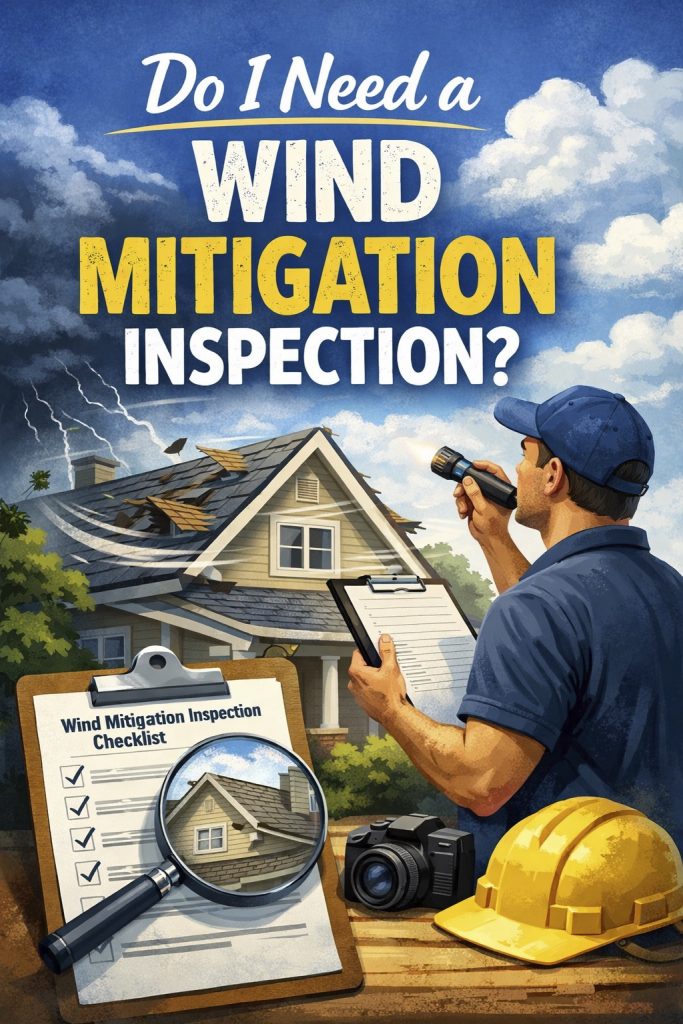
The Wind Mitigation Inspection That Could Save Tampa Homeowners Hundreds — And Why the New 2026 Form Changes Things
Most Tampa homeowners are paying more for home insurance than they need to — not because they’re over-covered, but because they haven’t taken one simple step that Florida law actually requires insurers to reward.
It’s called a wind mitigation inspection. It takes about an hour, typically runs around $120, and the discounts it can unlock often run into the hundreds of dollars per year. For many homeowners — especially those in older homes or homes built before Florida’s modern building codes took effect — it’s one of the smartest financial moves you can make.
And right now, there’s an added reason to pay attention: Florida just rolled out a brand new wind mitigation inspection form on April 1, 2026. If you’re due for an inspection — or thinking about getting one — here’s what changed, what it means for your discounts, and how to make sure you’re positioned to benefit.
What Is a Wind Mitigation Inspection?
A wind mitigation inspection is a formal assessment of your home’s ability to withstand hurricane-force winds. A licensed inspector examines specific structural features — your roof covering, roof shape, how your roof is attached to your walls, and what protections you have over windows and doors — and documents everything on a standardized state form.
That form goes to your insurance company. Florida law then requires your insurer to apply premium credits for every qualifying wind-resistant feature your home has. The more features documented, the larger the discount.
This is not optional for insurers: Under Florida Statute §627.0629, insurance companies must offer wind mitigation discounts. They’re not doing you a favor — they’re required to apply credits for documented wind-resistant features. If you’ve never had a wind mitigation inspection, you may be leaving significant money on the table right now. And as of April 1, 2026, all new inspections must use the updated OIR-B1-1802 (Rev. 04/26) form.
What Inspectors Actually Look At
The inspection covers six key areas of your home. Each one can contribute credits to your premium — and each one matters more as storms get more intense.
The material and installation method of your roof. FBC-compliant shingles installed to current standards earn better credits than older materials.
Hip roofs (four sloping sides) perform significantly better in hurricanes than gable roofs (triangular ends). Shape alone can move the premium needle meaningfully.
How your roof sheathing is nailed to the framing. Longer nails at closer spacing earn better credits — this is one of the biggest discount factors.
Hurricane straps (metal connectors that tie your roof structure to the walls) are a major credit factor. Many pre-2002 homes have toe-nailed connections — the weakest rating.
Impact-resistant windows, hurricane shutters, and reinforced garage doors protect your home’s envelope. This category carries some of the largest available credits.
Homes built or re-roofed under the 2002 Florida Building Code (FBC) automatically qualify for better base credits across several categories.
The New 2026 Form: What Tampa Homeowners Need to Know
On April 1, 2026, the Florida Office of Insurance Regulation (OIR) officially replaced the old inspection form — OIR-B1-1802 (Rev. 01/12) — with a new updated version: OIR-B1-1802 (Rev. 04/26). This is the first major overhaul of the form in many years, and every inspection conducted on or after April 1st must use the new version.
Here’s what changed and what it means for you:
- Stricter documentation requirements: The biggest shift is that inspectors must now provide comprehensive documentation — specific permits, product approval numbers, and high-resolution photos — for every credit claimed. Features that previously received credit based on general observation may now require hard proof.
- New data fields added: The updated form captures roof slope detail (homes with multiple slopes must now be individually indicated), geographic wind speed region, and FORTIFIED Home™ certification levels (Roof, Silver, and Gold).
- More standardization across carriers: The new form reduces the variation in how credits are interpreted between insurers, meaning more consistent results regardless of which company holds your policy.
- Based on updated building science: The 2026 form reflects a 2024 Residential Wind-Loss Mitigation Study — the first major research update since the program launched. Some features may qualify for different credit levels as discount tables are updated.
What about my existing report? If your current wind mitigation report (on the old form) was completed within the last five years and no material changes have been made to your home’s structure, most insurers — including Citizens — will continue to honor it until it expires. However, if your policy is renewed or modified after April 1, some carriers may request an updated inspection on the new form. When in doubt, ask your agent.
The new form’s emphasis on documented proof is most likely to affect pre-2002 homes where permit records are incomplete or aging features were previously given the benefit of the doubt by inspectors. If your home is older and your report is approaching its five-year expiration, get ahead of this — schedule the new inspection before hurricane season and before your renewal, not after.
Why Homes Built Before 2001 Need This Most
The 2002 Florida Building Code — adopted in the wake of Hurricane Andrew’s devastation in 1992 — dramatically raised the bar for wind-resistant construction. Homes built to this code are engineered to handle significantly stronger storms than what was required before.
If your Tampa home was built before 2002, it was almost certainly constructed to older, weaker standards. That doesn’t mean it’s unsafe — but it does mean your insurer may be pricing your policy as if it has the worst possible features in every category, because without a wind mitigation inspection, they don’t know otherwise.
Many pre-2002 homes have features that qualify for partial credits — updated roof coverings, hip roof shapes, even some early hurricane strap installations. Without an inspection, none of those features are being applied to your premium. You’re paying for uncertainty that an inspection would resolve in your favor.
❌ Without Inspection
$4,200Insurer assumes worst-case features in every category. Full wind premium applied with no credits.
✅ With Inspection Credits
$3,100Documented hip roof, FBC shingles, and hurricane straps applied. Over $1,100/year in savings — inspection paid for itself in weeks.
Example figures for illustrative purposes. Actual savings vary by home, insurer, and features documented.
What If My Home Doesn’t Have Great Features?
This is a fair question — and the honest answer is that a wind mitigation inspection is still worth doing, for a few reasons.
First, most homes have at least some qualifying features. Even if your roof deck attachment and wall connections don’t earn top credits, your roof shape or covering might. Partial credits are still real money.
Second, the inspection gives you a clear picture of exactly what upgrades would have the biggest impact on your premium. Impact windows and doors? A new roof with FBC-compliant installation? Hurricane straps added during a reroof? An inspector will document what you have now and what the documentation would look like after improvements — giving you a genuine cost-benefit framework for home upgrades.
Wind mitigation inspection reports are valid for up to five years, provided no material changes are made to your home’s structure. If your report is approaching expiration — or if you’ve had a new roof, impact windows, or hurricane shutters installed since your last inspection — it’s time to schedule a fresh one. With the new OIR-B1-1802 (Rev. 04/26) form now in effect, any inspection going forward will be on the updated form. The new features you’ve added won’t generate credits until they’re officially documented.
How to Get a Wind Mitigation Inspection in Tampa
In Florida, wind mitigation inspections must be performed by a licensed home inspector, building contractor, architect, or engineer — who must have completed at least 3 hours of OIR-approved hurricane mitigation training. Expect to pay around $120 for a standard inspection. This is not the same as your insurance company’s inspection — you hire this one yourself.
The inspector will need attic access to evaluate roof deck attachment and wall connections. Have any existing documentation ready — permits, roofing contracts, impact window certifications — as these can support better ratings.
As of April 1, 2026, all inspections use the new revised form. Your inspector will complete it and provide you with a copy along with supporting photos and documentation. Keep the original — you’ll need it for your agent and for future policy renewals.
Send the completed form to your agent as soon as you have it. Your insurer is required to recalculate your premium based on the documented features. Depending on your renewal date, you may receive a mid-term credit immediately.
Once the new credits are applied, go through the updated policy with your agent. This is also a good time to review whether your coverage limits are still appropriate — a full policy review takes 15–20 minutes and can catch issues beyond just wind mitigation.
Can’t Afford the Upgrades? Florida Has a Grant Program for That
Getting the inspection is step one — but what if the report comes back recommending expensive upgrades like impact windows, hurricane straps, or a new reinforced roof? Florida’s My Safe Florida Home (MSFH) program was designed exactly for this situation.
The program offers two benefits: a free wind mitigation inspection through the state, and matching grants up to $10,000 to help fund qualifying home-hardening improvements. For the 2025–2026 fiscal year, the Florida Legislature allocated $280 million for the program — but funding is first-come, first-served and has historically run out within weeks of the application window opening.
Key eligibility notes for the grant:
- Home must have an insured value of $700,000 or less
- Building permit must predate January 1, 2008 (home must be more than 17 years old)
- Must be a single-family detached home or townhouse (no condos, mobile homes, or rentals)
- Work must be done by a licensed Florida contractor — and you must wait for grant approval before starting any work
- It’s a reimbursement program — you pay first, then get reimbursed up to $10,000
Homeowners at or below 80% of their county’s median income may qualify for the full $10,000 grant without a matching contribution requirement. Standard applicants receive a 2-for-1 match — the state covers $2 for every $1 you spend, up to the $10,000 cap. Visit MySafeFLHome.com to check your eligibility and apply.
Other Discounts That Stack With Wind Mitigation
Wind mitigation credits are significant on their own — but they’re not the only lever. While your agent has the updated form in hand, it’s worth confirming you’re also getting credit for:
- New roof discount: A recently replaced roof (especially with FBC-compliant materials) can unlock additional credits beyond what wind mitigation alone documents.
- Home and auto bundle: Bundling your home and auto policies with the same carrier typically produces meaningful savings on both.
- Claims-free discount: Long claim-free history can qualify for loyalty and longevity discounts with many carriers.
- Protective devices: Monitored alarm systems, central fire detection, and automatic water shutoff devices may earn additional credits depending on your carrier.
- New home discount: Homes built within the last several years under current FBC standards may automatically qualify for better base rates.
“Wind mitigation is the most straightforward discount that most homeowners haven’t taken advantage of. You paid for the features — the hip roof, the hurricane straps, the impact windows. An inspection just makes sure your insurer knows about them.”
The Bottom Line for Tampa Homeowners
Tampa Bay sits in one of the most hurricane-vulnerable regions in the country, and Florida home insurance rates reflect that reality. You may not be able to change the market — but you can make sure you’re getting every discount your home qualifies for under the law.
A wind mitigation inspection typically costs around $120 — often less than a single month’s insurance premium — and can reduce your annual bill by hundreds of dollars, year after year, for as long as you own the home. With the new OIR-B1-1802 (Rev. 04/26) form now in effect, inspectors are held to stricter documentation standards, which means the credits that do come through are better supported and less likely to be challenged at renewal. If you’ve never had one — or if your home has changed since your last one — there’s no good reason to wait.
Ready to Find Out What Your Home Qualifies For?
We’ll review your current policy, walk you through the wind mitigation credits that apply to your home, and make sure you’re not overpaying. GRL Insurance has been helping Tampa Bay homeowners navigate Florida’s insurance market since 1983.
Call Us: (813) 393-4709