Do I Need an Umbrella Policy? What Most Tampa Homeowners Don’t Know About Their Liability Exposure
Most people think about insurance in terms of specific things — their car, their house, their health. But there’s a category of risk that falls outside all of those, and it’s one of the most underappreciated financial threats facing Florida families: personal liability exposure.
An umbrella policy is the solution — and it’s one of the most cost-effective forms of protection available. Yet most homeowners have never seriously considered whether they need one. Here’s how to think about it.
What Is an Umbrella Policy, Exactly?
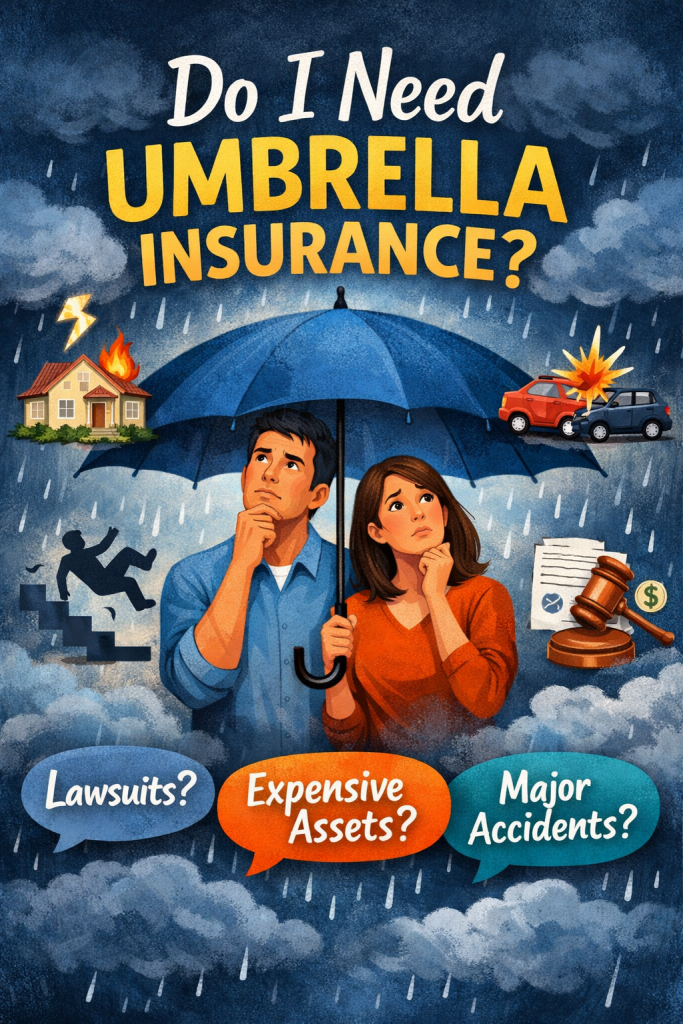
A personal umbrella policy is liability insurance that sits on top of your existing auto and home insurance. When a claim exceeds the liability limits on your underlying policies, your umbrella kicks in and covers the difference — typically in increments of $1 million.
It covers a wide range of liability scenarios: bodily injury you cause to others, property damage, certain lawsuits, and in many cases, incidents that happen away from your home or vehicle — situations your home or auto policy wouldn’t touch at all.
The cost often surprises people: A $1 million personal umbrella policy typically costs between $150 and $300 per year — roughly $15–$25 per month. For the amount of protection it provides, it’s one of the best values in the insurance world.
Why Florida Makes This Especially Important
Florida has one of the most litigious legal environments in the country. If you cause a serious car accident, someone is injured on your property, or your dog bites a neighbor, the resulting lawsuit can easily exceed the liability limits on a standard auto or home policy.
Standard auto policies in Florida carry relatively modest liability limits — and remember, Florida doesn’t even require Bodily Injury Liability coverage at all. A serious accident can generate six- or seven-figure judgments. Without an umbrella, anything beyond your policy limits comes directly out of your pocket — or more accurately, out of your assets.
What Florida Law Protects — and What It Doesn’t
Here’s something many Floridians don’t realize: Florida law actually provides strong statutory protection for certain assets from creditor judgments. Your retirement accounts, primary home (via the Homestead Exemption), life insurance cash value, and annuities are among the assets shielded under Florida statute.
But a significant portion of what most people have built up over their lives is not protected by law — and that’s exactly what a liability judgment can reach.
✅ Protected by Florida Law
- Primary home (Homestead Exemption)
- IRAs and pension accounts
- Profit sharing plans
- Federal pension / government retirement
- Annuities
- Life insurance cash value
- One vehicle (up to $1,000 value)
⚠️ Vulnerable Without Coverage
- Stocks, bonds, and mutual funds
- Cash savings & checking accounts
- Certificates of deposit
- Rental properties & vacation homes
- Additional vehicles, RVs, and boats
- Personal property
- Future income (wage garnishment)
The gap between those two columns is your real liability exposure. For many Tampa families — especially those who have built savings, own investment accounts, have a rental property, or own multiple vehicles — that gap is substantial.
Real Scenarios Where an Umbrella Policy Makes the Difference
You cause a multi-car accident on the highway. The other driver sustains serious injuries requiring surgery and long-term rehab. Medical bills and lost wages total $650,000. Your auto policy’s BI limit is $100,000. Without an umbrella, you’re personally on the hook for the remaining $550,000.
A guest is seriously injured using your backyard pool. Your home insurance liability limit is $300,000, but the resulting lawsuit — including pain and suffering — results in a $900,000 judgment. Your umbrella covers the $600,000 gap.
Florida has strict liability for dog bites — owners are responsible regardless of whether the dog has bitten before. A bite that causes facial scarring or nerve damage can result in a large settlement. Many home policies cap dog bite liability, and some exclude certain breeds entirely.
If you own a rental property in Tampa, your standard homeowners policy doesn’t cover it — and a landlord policy’s liability limits may not be sufficient if a tenant or visitor is seriously injured on the premises. An umbrella extends your protection here too.
Florida leads the nation in recreational boating accidents. A collision on the water that injures passengers or another vessel’s occupants can generate significant liability — often not covered under standard auto or home policies without a separate umbrella.
Who Should Seriously Consider an Umbrella Policy?
The honest answer is: most homeowners. But the need becomes especially clear if any of these apply to you:
- You have meaningful savings, investments, or assets beyond your protected accounts
- You own a rental property, vacation home, or vacant lot
- You have a pool, trampoline, or other attractive hazard on your property
- You own a dog (especially larger breeds)
- You have teen drivers on your auto policy
- You own a boat, RV, or ATV
- You have a high-profile profession or are perceived as having wealth
- You regularly host gatherings at your home
- You coach youth sports, lead volunteer activities, or have other community-facing roles
An umbrella policy doesn’t just protect what you have today — it protects what you’ll earn over the next 20 years. A judgment against you can attach to future wages, not just current assets. If you’re in your 30s or 40s with decades of earning ahead of you, your exposure is larger than your current net worth alone suggests.
See Your Own Exposure: Florida Asset Protection Calculator
We built a free tool specifically for this — the Florida Asset Protection Calculator. It walks you through exactly which of your assets are shielded under Florida statute and which are vulnerable without coverage. You enter your asset values, and it shows you your real protection gap in plain numbers.
Florida Asset Protection Calculator
Enter your assets to instantly see what Florida law protects and what remains at risk. The calculator covers:
- Legally protected assets under Florida statute (pensions, IRAs, homestead, annuities, life insurance)
- Vulnerable assets exposed to liability judgments (savings, investments, rental properties, vehicles)
- Your total protection gap — and how umbrella coverage fits in
“The most common reaction I see after someone uses this calculator is genuine surprise. They assumed Florida’s homestead laws protected more than they do. Seeing the real numbers — their savings accounts, their investment portfolio, their rental property — sitting in the ‘vulnerable’ column is usually enough to start a serious conversation.”
What an Umbrella Policy Doesn’t Cover
An umbrella policy is powerful, but it’s not unlimited. It generally does not cover:
- Your own injuries or property damage (it’s a liability policy, not a first-party coverage)
- Intentional or criminal acts
- Business-related liability (you’d need a commercial umbrella for that)
- Certain professional liability claims
- Damage to your own property
It also requires that you maintain minimum liability limits on your underlying home and auto policies — your insurer will specify what those floors are.
The Bottom Line
An umbrella policy is one of those coverages that most people don’t think about until they wish they had it. At $150–$300 per year for $1 million in coverage, the value proposition is almost unmatched in the insurance world.
If you’ve spent years building savings, paying down a mortgage, growing an investment account, or simply working toward financial stability — an umbrella policy is the simplest way to make sure one bad day on Dale Mabry Highway or one backyard accident doesn’t unravel all of it.
Want to Know If an Umbrella Policy Makes Sense for You?
Use the Florida Asset Protection Calculator to see your real exposure, then give us a call. We’ll walk you through your options — no pressure, just honest advice from a Tampa agent who’s been doing this for over 40 years.
Call Us: (813) 393-4709