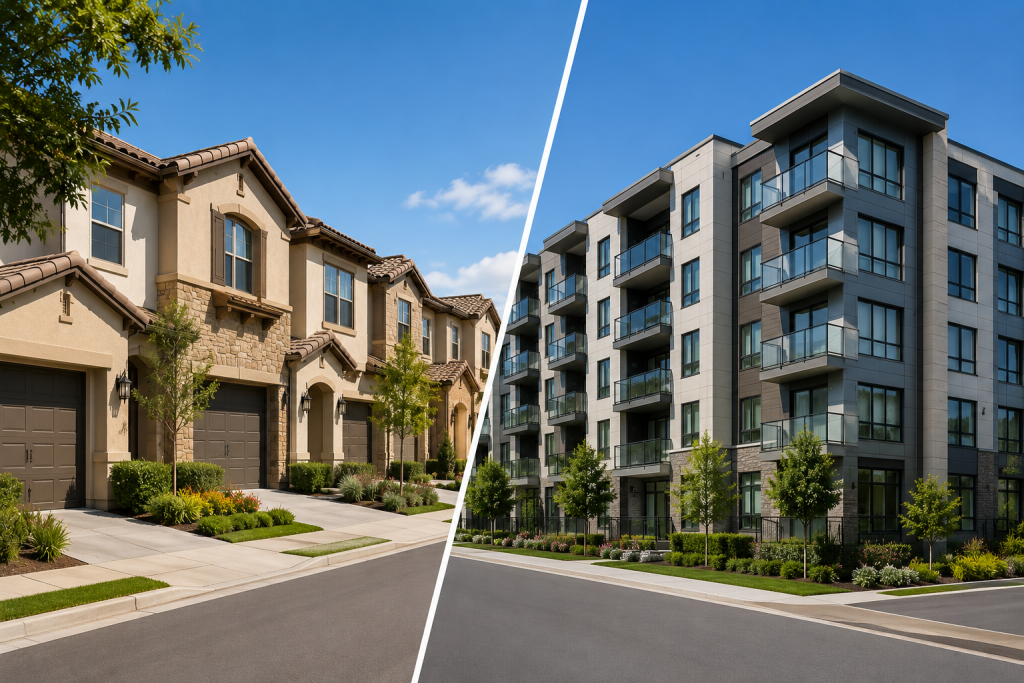
You found the perfect townhome in Wesley Chapel. The community has an association, the lawns are maintained for you, and the units share walls — so when it’s time for insurance, you call around asking for a condo policy. Then an agent tells you that you actually need an HO-3 homeowners policy, which costs more, and you can’t help wondering if you’re being upsold.
You’re not. And the reason comes down to one fact that surprises almost everyone: insurance doesn’t care what your home looks like. It cares what your deed says you own.
We have this conversation at our office almost every week, so here’s the full explanation — the same one we’d give you over the phone.
The Short Answer
If you own a townhome or villa in a community governed by a homeowners association (HOA), you almost always own the entire structure — roof, exterior walls, foundation, everything — plus the lot it sits on. That means you need an HO-3 homeowners policy that insures the whole building.
An HO-6 “condo” policy only exists for one situation: when a condominium association’s master insurance policycovers the structure, and you only need to insure from the drywall in. If your association isn’t a condominium association, there is no master policy covering your building — and an HO-6 would leave the entire structure uninsured.
A townhome with an HO-6 isn’t a money-saving hack. It’s a house with no insurance on the house.
Condo vs. Townhome: It’s About Ownership, Not Architecture
Two buildings can look identical from the street — attached units, shared walls, association-maintained landscaping — and have completely different legal structures underneath.
In a condominium, you own the airspace inside your unit. In Florida, condominiums are governed by Chapter 718 of the Florida Statutes, which requires the condo association to carry a master insurance policy covering the building’s structure and exterior. As the unit owner, you’re generally responsible for insuring from the unfinished drywall inward — your paint, flooring, cabinets, countertops, appliances, and personal belongings. That’s exactly what an HO-6 policy is built to do.
In a townhome or villa community with an HOA, you typically own your home fee simple — the structure and the land under it, lot line to lot line. These communities are governed by Chapter 720 of the Florida Statutes, and the HOA’s insurance obligation usually stops at the common areas: the entrance sign, the community pool, the retention pond. Your HOA may mow your lawn and even paint your exterior on a schedule, but maintaining something and insuring it are two different obligations. If a fire or hurricane destroys your townhome, the HOA’s policy pays nothing toward rebuilding it. That’s entirely on you — which is why you need the policy that covers an entire dwelling.
The deed is the tell. A condo deed describes a unit within a named condominium. A townhome deed describes a lot or parcel in a subdivision. Same idea with the association documents: a “Declaration of Condominium” means condo; a “Declaration of Covenants, Conditions and Restrictions” (CC&Rs) almost always means HOA and fee-simple ownership.
What Happens If You Buy the Wrong Policy
This is the part that makes us hold the line even when a caller is frustrated about price. Picture a townhome owner carrying an HO-6 when a kitchen fire spreads through the unit:
The HO-6 would respond to interior finishes and personal property, up to its limits — typically a fraction of what it costs to rebuild a home. The structure itself — framing, roof, exterior walls, the actual house — would have no coverage at all. On a Tampa-area townhome, that’s easily a six-figure gap coming out of the owner’s pocket. After a hurricane, multiply that scenario across an entire community.
And there’s a second problem: your mortgage. Lenders require insurance that matches your ownership. If your loan is on a fee-simple townhome and your insurance is a condo policy, expect a letter from your mortgage company — possibly followed by force-placed insurance, which is dramatically more expensive than any HO-3 and protects the lender, not you.
“But My Neighbor Has an HO-6…”
We hear this one a lot, and it deserves a real answer instead of a brush-off. A few possibilities:
Your neighbor’s section of the community may genuinely be a condominium — some larger Tampa Bay developments contain both condo buildings and fee-simple townhomes under different declarations, sometimes across the street from each other. Or your neighbor’s policy may simply be wrong, written years ago by someone who didn’t check the documents, and nobody will discover the problem until claim time — the worst possible moment to find out.
There’s also a genuine exception worth knowing about: a small number of HOA villa communities have governing documents that obligate the association to insure the building structures, condo-style. It’s uncommon, but it exists — and in those communities, a walls-in policy can be the right call. This is exactly why the answer is never “townhomes always get HO-3” recited from memory. The answer lives in your community’s governing documents, and reading them is part of our job.
Why the HO-3 Costs More (and Why That’s Fair)
An HO-6 is cheaper because it’s insuring less — interior finishes and contents, with the big-ticket structural risk carried by a condo association’s master policy (which, by the way, you pay for through your condo fees; the cost doesn’t disappear, it just moves).
An HO-3 on a townhome is insuring an entire Florida dwelling: the roof and exterior walls that take the brunt of hurricane season, the full reconstruction cost if the worst happens, plus your contents, liability, and loss-of-use coverage if you’re displaced during repairs. In Florida, the roof and windstorm exposure are the expensive part of any property policy — and on a fee-simple townhome, that exposure is yours.
The good news: townhomes often price better than comparable single-family homes (shared walls mean less exterior surface), and bundling with your auto insurance helps. The premium difference between HO-6 and HO-3 isn’t an upsell — it’s the difference between insuring a slice of a building and insuring the building.
How to Find Out What You Actually Need
If you’re not sure which side of the line your home falls on, here’s what settles it:
- Check your deed. “Unit” and “condominium” point to HO-6 territory. “Lot,” “parcel,” or a subdivision name points to HO-3.
- Look at your association documents. A Declaration of Condominium means Chapter 718 and a master structural policy. CC&Rs from an HOA mean Chapter 720 and the structure is on you — unless the documents specifically say otherwise.
- Ask the association for proof of its master insurance and what it covers. If there’s no master policy covering buildings, the question is answered.
- Bring it all to a local agent. This is genuinely a five-minute review for someone who reads these documents every week.
We do this review for Tampa Bay townhome and villa owners all the time — Wesley Chapel, New Tampa, Land O’ Lakes, Riverview — at no charge and with no obligation. If your documents say you’re a condo, we’ll write you the HO-6. If they say you own the structure, we’ll quote the HO-3 and make sure the dwelling limit reflects real reconstruction costs, not a guess.
Either way, you’ll have the policy that actually pays when something goes wrong — which is the only kind worth buying.
Have a townhome or villa and not sure which policy you need? Call GRL Insurance at (813) 393-4709 or request a free quote online — and if you have your deed or HOA documents handy, even better. We’ve been sorting out exactly this question for Tampa Bay families since 1983.
Related reading: Home Insurance Guide · Flood Insurance Guide · Renters Insurance Guide
Frequently Asked Questions
Can I buy an HO-6 policy for my townhome to save money? Only if your community is legally a condominium with a master policy insuring the structure. If you own your townhome fee simple in an HOA community, an HO-6 leaves the entire building uninsured, and most carriers won’t issue one once the ownership type is verified.
My HOA paints the exterior and maintains my roof. Doesn’t that mean they insure it? No. Maintenance obligations and insurance obligations are separate. Many HOAs handle upkeep of exteriors while the governing documents make each owner responsible for insuring their own structure. The documents — not the maintenance schedule — determine who insures what.
How do I know if my community is governed by Chapter 718 or Chapter 720? Check your closing documents or the county records. A “Declaration of Condominium” means Chapter 718 (condo). A “Declaration of Covenants, Conditions and Restrictions” from a homeowners association means Chapter 720 (HOA), where owners typically insure their own homes.
What if I’ve had the wrong policy for years and never had a claim? You’ve been lucky, not covered. Switch before luck runs out — there’s no penalty for correcting it, and your lender will eventually catch the mismatch anyway. An agent can transition you to the correct form at renewal or mid-term.
Does an HO-3 on a townhome cover my shared walls? Yes. Carriers write fee-simple townhomes on HO-3 forms routinely, including party walls. Your policy covers your dwelling as described in your deed; your attached neighbor’s policy covers theirs.